> ## Documentation Index
> Fetch the complete documentation index at: https://mintlify.com/mlfoundations/open_clip/llms.txt
> Use this file to discover all available pages before exploring further.
# Contrastive Learning
> Understanding how CLIP learns visual-semantic embeddings through contrastive loss
# Contrastive Learning in CLIP
Contrastive learning is the training methodology that enables CLIP to learn aligned visual and semantic representations. The key insight: **maximize agreement between matched image-text pairs while minimizing agreement between mismatched pairs**.
## Core Concept
Given a batch of N (image, text) pairs:
1. Encode all images → N image embeddings
2. Encode all texts → N text embeddings
3. Compute N×N similarity matrix
4. Train to maximize diagonal (correct pairs) and minimize off-diagonal (incorrect pairs)
**Symmetric Loss**: CLIP computes loss from both image→text and text→image directions, ensuring bidirectional alignment.
## The Contrastive Loss Function
OpenCLIP implements the contrastive loss in `src/open_clip/loss.py`. The core loss is a **symmetric cross-entropy loss** over the similarity matrix.
### Implementation
From `src/open_clip/loss.py:68-155`:
```python theme={null}
class ClipLoss(nn.Module):
def forward(
self,
image_features,
text_features,
logit_scale,
logit_bias=None,
output_dict=False,
):
device = image_features.device
# Compute similarity matrix (N×N)
logits_per_image, logits_per_text = self.get_logits(
image_features,
text_features,
logit_scale,
logit_bias=logit_bias,
)
# Ground truth: diagonal matrix (i-th image matches i-th text)
labels = self.get_ground_truth(device, logits_per_image.shape[0])
# Symmetric cross-entropy loss
total_loss = (
F.cross_entropy(logits_per_image, labels) +
F.cross_entropy(logits_per_text, labels)
) / 2
return {"contrastive_loss": total_loss} if output_dict else total_loss
```
### Logits Computation
From `src/open_clip/loss.py:104-130`:
```python theme={null}
def get_logits(self, image_features, text_features, logit_scale, logit_bias=None):
if self.world_size > 1:
# Gather features from all GPUs for large batch sizes
all_image_features, all_text_features = gather_features(
image_features,
text_features,
...
)
logits_per_image = logit_scale * all_image_features @ all_text_features.T
logits_per_text = logit_scale * all_text_features @ all_image_features.T
else:
# Single GPU: compute scaled cosine similarity
logits_per_image = logit_scale * image_features @ text_features.T
logits_per_text = logit_scale * text_features @ image_features.T
if logit_bias is not None:
logits_per_image += logit_bias
logits_per_text += logit_bias
return logits_per_image, logits_per_text
```
## Mathematical Formulation
Given normalized embeddings **I** (images) and **T** (texts):
### Similarity Matrix
```
S = τ · I · T^T
```
Where:
* **τ** (tau) = `logit_scale.exp()` - learnable temperature parameter
* **S\[i,j]** = scaled cosine similarity between i-th image and j-th text
### Loss Function
```
L = 1/2 * [L_i2t + L_t2i]
L_i2t = -1/N * Σ log(exp(S[i,i]) / Σ_j exp(S[i,j])) # Image to text
L_t2i = -1/N * Σ log(exp(S[i,i]) / Σ_j exp(S[j,i])) # Text to image
```
This is equivalent to **cross-entropy loss** with ground truth labels on the diagonal.
## Visual-Semantic Embedding Space
Contrastive learning creates a **joint embedding space** where:
### Positive Pairs (Matching)
* Image of "a dog playing fetch" ↔ Text "a dog playing fetch"
* Model learns to embed these **close together**
* High cosine similarity (→ 1.0)
### Negative Pairs (Mismatched)
* Image of "a dog playing fetch" ↔ Text "a cat sleeping"
* Model learns to embed these **far apart**
* Low cosine similarity (→ 0.0 or negative)
### Emergent Properties
Through large-scale contrastive training:
1. **Semantic clustering** - Similar concepts cluster together
2. **Cross-modal alignment** - "dog" (text) aligns with dog images
3. **Compositional understanding** - Model learns objects, actions, attributes
4. **Zero-shot transfer** - Embeddings generalize to unseen concepts
## Training Objective and Batch Construction
### In-Batch Negatives
CLIP uses an efficient strategy: **in-batch negatives**
* Batch size N creates N positive pairs
* Each pair has (N-1) negative examples from other samples
* Total comparisons: N² (N positive + N(N-1) negative)
**Large batch sizes are critical** for contrastive learning. More negatives = better training signal. OpenCLIP supports batch sizes up to 100K+ across distributed GPUs.
### Batch Construction Example
Given batch size N=4:
```
Images: [img0, img1, img2, img3]
Texts: [txt0, txt1, txt2, txt3]
Similarity Matrix (4×4):
txt0 txt1 txt2 txt3
img0 [HIGH low low low ] ← img0 matches txt0
img1 [ low HIGH low low ] ← img1 matches txt1
img2 [ low low HIGH low ] ← img2 matches txt2
img3 [ low low low HIGH ] ← img3 matches txt3
Goal: Maximize diagonal, minimize off-diagonal
```
### Ground Truth Labels
From `src/open_clip/loss.py:91-102`:
```python theme={null}
def get_ground_truth(self, device, num_logits) -> torch.Tensor:
# Ground truth: each image i should match text i
labels = torch.arange(num_logits, device=device, dtype=torch.long)
if self.world_size > 1 and self.local_loss:
# Adjust labels for distributed training
labels = labels + num_logits * self.rank
return labels
```
Labels are simply `[0, 1, 2, ..., N-1]` - each sample matches its corresponding index.
## Advanced Training Techniques
### Local Loss
For distributed training, compute loss locally on each GPU to save memory:
```python theme={null}
if self.local_loss:
# Only compute gradients for local image features
logits_per_image = logit_scale * image_features @ all_text_features.T
logits_per_text = logit_scale * text_features @ all_image_features.T
```
Reduces space complexity from O(n²) to effectively O(n).
### Gather with Gradient
Enable gradient flow during all-gather operation:
```python theme={null}
if gather_with_grad:
all_image_features = torch.cat(torch.distributed.nn.all_gather(image_features))
all_text_features = torch.cat(torch.distributed.nn.all_gather(text_features))
```
Allows backpropagation through distributed features.
### SigLIP Loss (Alternative)
OpenCLIP also implements SigLIP loss from `src/open_clip/loss.py:330-464`:
```python theme={null}
class SigLipLoss(nn.Module):
""" Sigmoid Loss for Language Image Pre-Training (SigLIP)
Uses sigmoid instead of softmax for better scaling.
"""
def _loss(self, image_features, text_features, logit_scale, logit_bias=None):
logits = self.get_logits(image_features, text_features, logit_scale, logit_bias)
labels = self.get_ground_truth(...)
loss = -F.logsigmoid(labels * logits).sum() / image_features.shape[0]
return loss
```
Benefits:
* Better scaling to very large batches
* No softmax normalization overhead
* Independent per-pair loss computation
## Training Configuration
Example training with contrastive loss:
```bash theme={null}
python -m open_clip_train.main \
--train-data="/data/laion400m/{00000..41455}.tar" \
--batch-size=256 \
--epochs=32 \
--model=ViT-B-32 \
--local-loss \ # Enable local loss for memory efficiency
--gather-with-grad # Enable gradient gathering
```
### Key Hyperparameters
* **Batch size**: Larger = more negatives = better training (256-32K typical)
* **Learning rate**: 5e-4 to 1e-3 typical for CLIP
* **Warmup**: Gradual learning rate increase (2000-10000 steps)
* **Temperature (τ)**: Learned, initialized to \~2.66
## Loss Curves
During training, monitor:
1. **Contrastive loss** - Should decrease steadily
2. **Accuracy** - Top-1/Top-5 on diagonal predictions
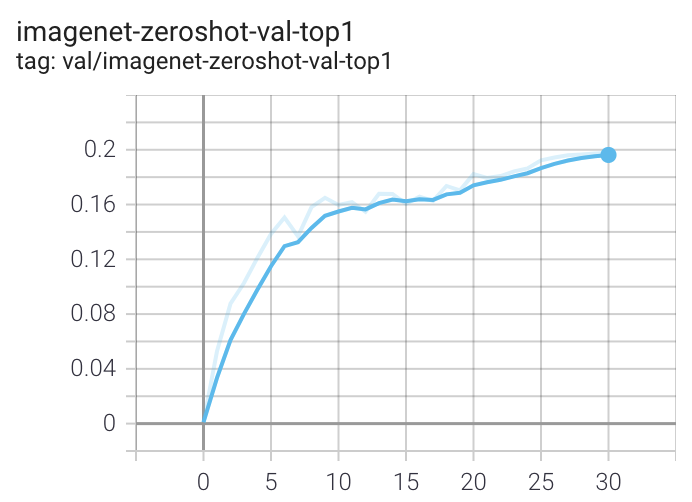
3. **Zero-shot metrics** - Periodic ImageNet zero-shot evaluation
From the README:
> When run on a machine with 8 GPUs the command should produce the following training curve for Conceptual Captions
 ## Reference Implementation
Key files:
* **`src/open_clip/loss.py`** - ClipLoss, SigLipLoss, CoCaLoss implementations
* **`src/open_clip/model.py:265-480`** - CLIP model with forward pass
* **`src/open_clip_train/train.py`** - Training loop
## Related Concepts
High-level architecture and design principles
How contrastive embeddings enable zero-shot inference
## Further Reading
* **Original CLIP Paper**: [Learning Transferable Visual Models From Natural Language Supervision](https://arxiv.org/abs/2103.00020)
* **SigLIP Paper**: [Sigmoid Loss for Language Image Pre-Training](https://arxiv.org/abs/2303.15343)
* **OpenCLIP Scaling Laws**: [Reproducible scaling laws for contrastive language-image learning](https://arxiv.org/abs/2212.07143)
## Reference Implementation
Key files:
* **`src/open_clip/loss.py`** - ClipLoss, SigLipLoss, CoCaLoss implementations
* **`src/open_clip/model.py:265-480`** - CLIP model with forward pass
* **`src/open_clip_train/train.py`** - Training loop
## Related Concepts
High-level architecture and design principles
How contrastive embeddings enable zero-shot inference
## Further Reading
* **Original CLIP Paper**: [Learning Transferable Visual Models From Natural Language Supervision](https://arxiv.org/abs/2103.00020)
* **SigLIP Paper**: [Sigmoid Loss for Language Image Pre-Training](https://arxiv.org/abs/2303.15343)
* **OpenCLIP Scaling Laws**: [Reproducible scaling laws for contrastive language-image learning](https://arxiv.org/abs/2212.07143)